In this competitive market, having a positive digital experience is what sets your brand apart and plays a crucial role in shaping your brand’s growth, perception and longevity.
Digital Experience Report
5 Ways Leading Building Materials Brands are Harnessing the Power of Digital Experience

A website is your digital storefront. A central hub that houses your product inventory, resource materials and sales team information. But more than that, a website is the most important and influential marketing tool that can make or break a user’s digital brand experience. A seamless digital experience can make it easy for customers to navigate and find what they need, consume your content, expedite problem resolutions and find that sense of trust they are looking for with your brand. In this competitive market, having a positive digital experience is what sets your brand apart and plays a crucial role in shaping your brand’s growth, perception and longevity.
As an agency committed to transforming digital experiences in the building materials space, we wanted to get a deeper understanding of how brands in this industry were measuring up. So, we analyzed 200 of the leading building materials websites to see how they rank in their digital experience. Using a series of best-in-class criteria, here’s an overview of what we found top building materials brands are implementing on their websites:
- Tracking tools that provide insights into their customer’s behaviour, actions and interests;
- Interactive design that helps users envision products in real-use scenarios;
- Chatbots that are answering questions and solving problems, all while saving time;
- Content leveraged effectively to create powerful, personalized experiences; and
- Dealer locator elements that easily connect users with nearby products and sales teams.
Scroll down to learn which digital enhancements are hitting the mark and driving growth, so you can get inspired to transform your own online presence.
Tracking Tools
19% of the top building materials websites are using GA4 or other tracking tools to learn about their customers.
Who’s coming to your site? Where are they located? What products are they looking at? This is what tracking can tell you. Whether you have Universal Analytics, GA4, HotJar, etc., these tools give you the information needed to make data-driven decisions. From identifying which channels and devices users are using to which pages they’re spending the most time on, tracking allows you, as marketers, to have real-time data about user behaviour. This is data that you can then use to better understand your target audience, create more targeted ad campaigns and provide a more relevant brand experience that will ultimately drive more conversions and sales. Want a holistic view of user behaviour and engagement? Link your CRM system to your Google Analytics or tracking tool to gain deeper insights into your audience.
> How you can build on this…
Get tracking. If you don’t already have tracking set up on your website, now’s the time to make it a priority. With Google Analytics 4, basic setup is simple. The sooner you start tracking, the more historical data you will gather. Plus, there are a number of free tracking tools that can help get you started. When you start tracking, be sure to track custom events that are important to your business (button clicks, form submissions, content downloads, etc.) so you can start to form insights on how your website is performing.
Customize it for your needs. Do you care about the volume of sessions? Engagement? Conversions? Are you looking to attract more new visitors, or better retain existing ones? Find a tracking tool that records the metrics that are important to you and align with your business objectives.
Continue to look at the data. Compare data from the previous month or year and see if there are any trends or patterns. Do you see a spike or fall during certain times of the year? Or with major industry changes? The data can often inform you of any larger forces that could be impacting users and therefore your business.
Interactive Design
8% of the top building materials websites have interactive design elements.
Yes, this number is low. But we’re actually not surprised. That’s because a lot of building materials websites out there still have kinks to work out. Whether it’s creating straightforward navigation or clean design, those elements are higher on the priority list when it comes to making a good impression. However, once those things are in place, interactive design can really make your website shine. More than just a nice-to-have, interactive design can hold a lot of value for customers and businesses that many building materials brands haven’t tapped into yet.
From parallax effects and background videos to animations, subtle enhancements give users a better digital experience by immersing them in your site. You can also take things one step further by adding product visualizers. This type of interactive design shows off your building materials product in every angle, colour and scenario, so users get a sense of how and where they can use it.
> How you can build on this…
Consider your customers first. Again, it’s more important to have a website that’s clear, clean and customer focused. Think about what they want and why they’re coming to your site. Then you can open up the possibilities to which design elements could support their experience.
Incorporate interactive design in a variety of ways. Interactive design can be applied to so many areas of your website. From maps to infographics to calculators, it can help make your content come to life and make a positive impression on your customers.
Chatbots
7% of the top building materials websites have an alternative type of form submission, like a chatbot.
This finding was a surprising one for us, because we’ve seen how quickly chatbots have evolved, how much value they bring for businesses and consumers and how quickly brands have integrated them into their sites. Chatbots are much more conversational than they used to be. With the advancements in AI, chatbots have evolved to generate better responses, using natural language, with the capacity to have personalized conversations with users. In fact, research shows that compared to traditional website forms, businesses utilizing chatbots can achieve a 36% higher conversion rate. So why do chatbots perform well? Because they are available to assist a user any time, anywhere. This often makes them the first form of contact a user will have. Chatbots can record a user’s contact information and their questions, and can either provide immediate solutions or arrange a follow-up with someone on your sales team. Chatbots allow a user to feel engaged and understood, and provide a practical next step. Additionally, having a chatbot saves businesses time and resources. They have the capacity to have unlimited interactions and quick response times, which places less stress on customer service teams and sales agents, and enhances your customer service.
> How you can build on this…
Personalize the conversation. In order to engage with your audience, you need to understand them. You can use data from your website analytics, focus groups and surveys to understand what your audience needs and their pain points, so you can tailor your chatbot’s tone, language and responses to cater to them.
Take the conversation past hello. Once you’ve started a conversation, and depending on a user’s needs, there might be opportunities for your chatbot to offer up different solutions through your products and services. Would they like to know about your upcoming webinar or new product? A chatbot can nurture a lead just as easily as it can receive one.
Not sure how to create a chatbot conversation flow? Here’s an example of how to nurture and qualify the right type of leads into your marketing funnel.
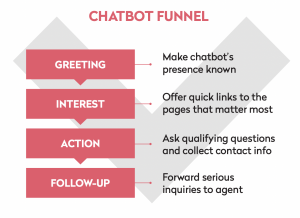
Funnel Content
25% of the top building materials brands have content for every stage of the buying journey.
The most successful building materials brands know their audience well enough to create ample content that speaks to their needs and answers their burning questions. From awareness to consideration to decision making, these websites have the content needed to help guide buyers along their journey, while building trust and value at every step. What are some types of content that we noticed were impactful? Educational pieces, installation videos, before-and-after projects and influencer content are some examples that hold a lot of value for building materials brands.
> How you can build on this…
Create content with intention. How much content should you be creating? The answer is to base it on what customers want (not what you want to tell them). Understanding how your audience thinks, what they’re asking and the journey they take (from research to installation) is your first step to mapping the content that matters most. As a first step, be sure to talk to your sales teams to learn the common questions your customers are asking, and spend some time researching common search queries. Both of these are great tactics when considering the needs of your customers. As an added bonus, when you create content that’s tailored to specific questions your audience is asking, your SEO rankings and domain authority get higher.
Slice and dice your content. One piece of content can actually turn into many. A lengthy blog post could be sliced into sections, each one aligning with different stages of the buyer’s journey, covering everything from product benefits to product comparisons to installation videos.
Dealer Locator
25% of the top building materials brands reviewed feature a dealer locator on their website.
Having a dealer locator element on your website is an easy way for users to:
A: access the product they want at a nearby location, and
B: access a dealer who can help them learn more – whether that’s at a physical location or not.
For building materials brands with several physical showrooms, store locations or retail partnerships, a dealer locator is crucial for connecting users to your products. It can also help engage your dealers, allowing them to connect with potential customers easier.
> How you can build on this…
Make it a clear and intuitive experience. From address fields to map pins and dropdown menus, make sure everything is clear and simple to understand. You can also take advantage of location auto-detection, and browsing tabs so users don’t have to manually enter information in, saving them time.
Optimize website listings and your Google My Business profile. Make sure that all of your contact information is up to date and accurate on every platform. Include things like address, phone number, email address, etc. Doing this can help to positively impact your local SEO rankings, local search campaigns and more.
See if your website makes the grade.
Want to know how your website ranks with the competition? Our website grader analyzes every digital aspect of your website and identifies the gaps, so your website can work harder to drive growth for your business. Visit https://jkbuild-websitegrader.com/ to get started.
More Reports and Guides
 " alt="" loading="lazy" role="presentation" />
Building Materials
Does Your Building Materials Brand Have a Place on TikTok?
See how building materials brands can jump on the TikTok bandwagon and connect with audiences in a new way. Read more " alt="" loading="lazy" role="presentation" />
Building Materials
3 B2B Contrarian Trends to Keep an Eye On
Jeff Lancaster of the B2B Institute at LinkedIn shares some top B2B trends for contrarian marketers. Read more" alt="" loading="lazy" role="presentation" />
Building Materials
Digital Experience Report
In this competitive market, having a positive digital experience is what sets your brand apart and plays a crucial role in shaping your brand’s growth, perception and longevity. Read moreKeep up to date with everything related to JKBuild.
Want to sign up for updates, announcements, offers and promotions from Jan Kelley? Simply fill in the form below and we’ll keep you up to date. You may later withdraw your consent at any time. Check out our Privacy Policy.